Acute–Chronic segregation policy
One Flew Over the Cuckoo's NestThe Acute–Chronic segregation policy organizes the day room around a boundary between patients considered Acutes and those classified as Chronics. The separation is maintained not only by staff direction but by patients’ own reluctance to cross it: the arrangement makes the ward’s hierarchy visible and allows the prospect of becoming a Chronic to function as a warning.
Arrangement and Enforcement
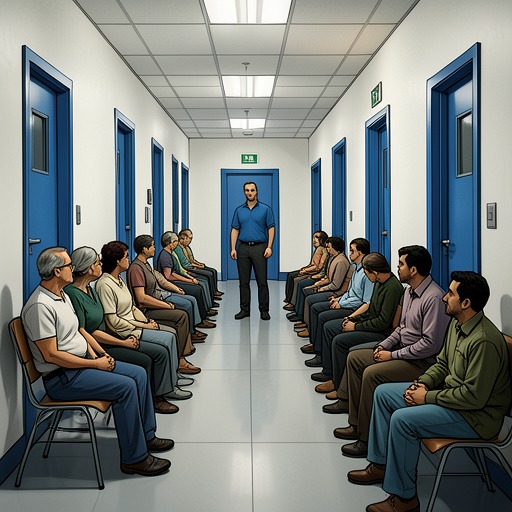
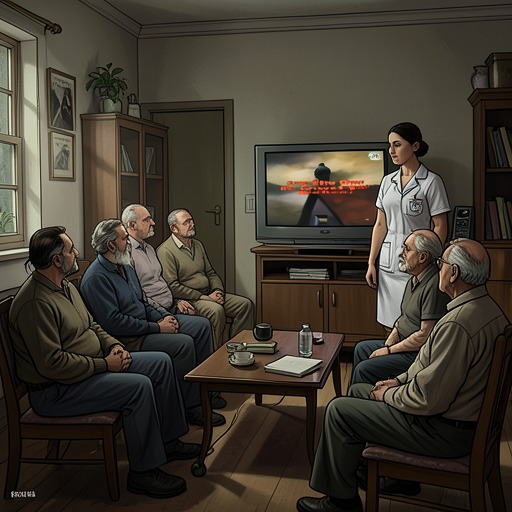
The Chronics and Acutes generally occupy opposite sides of the day room. After breakfast, the black boys move the patients into position, inspect the grouping, and signal that it should remain as arranged. They justify the division as a matter of order, presenting the sides as an ordinary and settled feature of ward life rather than as a policy patients might contest.
The division is sustained partly through habit. Apart from Chief Bromden, the Chronics rarely move around much, while the Acutes say they would rather stay on their own side. They cite the Chronic side’s smell, but Chief Bromden understands their deeper reluctance as fear: the Chronics embody what the Acutes believe could happen to them. The boundary therefore separates patients physically while also keeping the prospect of decline in view.
Fear as Discipline
Nurse Ratched recognizes that fear and uses it to secure compliance. When an Acute becomes sulky, she can invoke the possibility of ending up among the Chronics and present cooperation with staff policy as necessary for a cure. The threat gives the distinction practical force: remaining on the preferred side appears conditional on behaving as the institution expects.
The ward’s account of its success makes the arrangement’s institutional purpose visible. A brass plaque mounted on a piece of maple hangs above the logbook, centered between the two groups; it congratulates the ward for getting along with the smallest number of personnel in the hospital. The award turns patient cooperation into a public measure of efficiency. Its position between the Acutes and Chronics places that praise directly over the division it helps normalize.
McMurphy’s Arrival
When Randle Patrick McMurphy arrives, he quickly recognizes that he is not a Chronic and goes directly to the Acute side. He shakes hands, jokes, and laughs loudly. The Acutes respond with unease, as if his unruly behavior might provoke the staff to impose consequences on everyone. His arrival does not immediately abolish the separation, but his conspicuous ease among the Acutes unsettles the quiet compliance on which the ward’s arrangement depends.
Significance
The policy works through both staff authority and patient self-policing. The black boys arrange the sides and affirm the rule, but the Acutes’ fear and the Chronics’ limited movement help keep it in place even without continual commands. Calling the division orderly, or presenting cooperation as part of treatment, obscures how it also sorts patients by status and makes one group’s condition a disciplinary threat to the other. In the day room, the gap between the two sides is not merely spatial: it is a daily reminder of who is expected to recover, who is treated as beyond recovery, and what the Acutes risk becoming if they fail to comply.